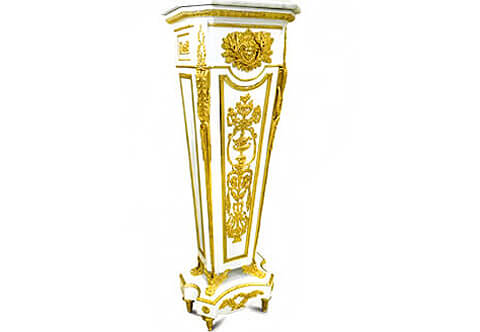
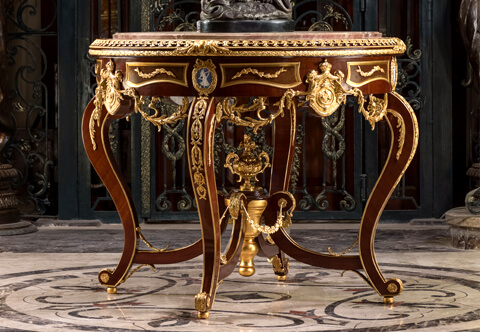
A Royal French Louis XV Revival style ormolu-mounted, veneer and marquetry inlaid grand Pedestal after the model by François Linke after the model by Joseph-Émmanuel Zwiener; Late 19th Century
Ref#ST-3569 | Description
This grand pedestal was produced in love with the tradition of high-style Parisian cabinetmaking that flourished during the Belle Époque, when Rococo forms were revived with exceptional technical sophistication. Its design follows models established by Joseph-Emmanuel Zwiener’s commissions for the Prussian royal residences (c. 1880s) and later adapted by Linke’s early production showcased at the 1900 Exposition Universelle. Its craftsmanship aligns with pieces documented in the literature on the Zwiener-Linke design continuum.
The exquisite piece is sans-traverse quarter cut double veneer inlaid, the inset leveled marble top above, is within a fluted ormolu cornice accented with curved acanthus and central X bands above a swelling curvature body form articulated on each corner with an imposing finely chased four grand lion masks chutes, head-dressed with floral swaging drapery issuing an acanthus head bold trim extended to the fine acanthus-sheathed ormolu paw feet; a sculptural treatment characteristic of the most ambitious Parisian bronziers of the Belle Époque period.
Flanking on each side a richly modeled Rococo style ormolu encaderement starts with an acanthus curved cartouche surmounted with a buttoned branched curved laurel garland and finely inlaid with Rayonnant veneer pattern connected to the bottom with a very fine curved double floral contour flanking a loose floral bouquet marquetry patterns; The pedestal lower part is embellished with a hammered ormolu acanthus trim issuing a large blossoming acanthus leaf.
A piece of this refinement—marrying high-relief bronze work with precision marquetry—reflects the height of Belle Époque cabinetmaking and the enduring influence of Paris’s most celebrated ateliers.
As a functional support for clocks, sculpture, or porcelain, it would have occupied a prominent position within a formal salon or grand hall, serving as both an architectural accent and a testament to elite Parisian furniture-making.
Ref#ST-3569
H:140 x W:50 x D:50cm
Louis XV Revival Style | Belle Époque
Joseph-Émmanuel Zwiener
Joseph-Émmanuel Zwiener was born in Heidau, Snesia, circa 1848 and died in 1925. He is listed as working in Paris between 1880-1895 at the rue de la Roquette. Present scholarship suggests that Joseph Emmanuel Zwiener and the ebeiste Julius Zwiener, who worked in a remarkably similar style are the same maker.
Joseph Emmauel is not recorded in Paris after 1895. At that point, the Paris workshop appears to have been taken over by another important emigre and ebiniste Francois Linke. It is thought that the sculptor Leon Mesange who orginally worked with Zwiener may have transferred to Linke’s workshop when Zwiener ceased trading in Paris in 1895. THe high quality of the ebenisterie and the gilt-bronze mounts are characteristic of Zwiener’s work.
As Mesage worked for Linke and Zwiener in the same style, many of Zwiener’s pieces have been attributed to Linke. In order to differentiate commissions, the bronzes were often marked on the reverse side with the maker’s initials. Several of Zwiener’s mounts have been found with a “Z”, a “ZW”, or “IZ”, on the reverse. other pieces have been found with a signature and/or date. In 1889, the firm won a gold medal at the Exposition Universelle for a Jewel Cabinet. The jury noted “es ses debuts a une Exposition Universelle (il) s’est mis au premier rang par la richesse et le fini de ses meubles incrustes de bronze et fort habilement marquestes”. In 1898, Julius Zwiener was commissioned to make an important bedroom suite for Kaiser Wilhelm II.
François Linke
Francois Linke (1855-1946) was arguably the leading Parisian cabinetmaker of the Belle Epoque the glittering age of fashionable French society, whose influence was felt throughout the world.
Determined to outshine the competition at the Exhibition, Linke had set about creating the most ambitious pieces he could envisage, and more extravagant than had ever been displayed before. The items he exhibited marked a transition from the historicist interpretation of Louis XV and Louis XVI styles, an interpretation that was the mainstay of his nearest rivals, to something startlingly new and vital in its immediacy. Together with Leon Message he developed a new style for the 1900 Exhibition that paid homage to the Louis XV rococo in the fluidity of its approach, but an approach fused with the lively flowing lines of the contemporary and progressive 'art nouveau'.
This risky endeavour was a resounding success, and with his reputation established, La Maison Linke became the pre-eminent furniture house until outset of the Second World War. The technical brilliance of his work and the artistic change that it represented was never to be repeated. His showrooms expanded into prestigious premises in Paris, in the Place Vendome as well as the Faubourg St. Antoine where his workshop had been established. He embarked on many important commissions in the years up to the outbreak of the First World War, making and designing furniture for leading international industrialists and bankers.
After the 1914-1918 World War, Linke undertook the extraordinary commission to furnish the Ras al-Tin Palace in Alexandria for King Fuad of Egypt, possibly the largest single furniture commission ever conceived, eclipsing even Versailles. Linke flourished and remained active until the middle years of the 1930s and died in 1946.
.jpg)