A sumptuous Belle Époque French Louis XV Rococo Revival style ormolu-mounted veneer inlaid Grand Fauteuil De Bureau after the model by François Linke. Circa 1900
Ref#SN-8744 | Description
A monumental Belle Époque French Louis XV Rococo Revival style ormolu-mounted and sans-traverse veneer inlaid (Fauteuil De Bureau) Office Armchair, after the model by François Linke Index No.703, Paris, Circa 1900, with a curvilinear, cartouche-shaped back and open arms. The exquisite frame is outlined and ornamented with continuous ormolu molding that accentuates the sinuous silhouette.
This sumptuous armchair is hand-made by our craftsmen to exemplify the late-19th-century Parisian revival of the Louis XV repertoire, combining the sinuous, asymmetrical lines of 18th-century Rococo with the technical bravura favored by the great haute-luxe ébénistes of the period;
Upholstered in rich burgundy leather, secured with patinated brass nailhead trim. The crest rail is in Rocaille-pediment centered by a prominent, sculptural Agrafe containing a high-relief female Mascaron. The visage is framed by stylized, asymmetrical acanthus foliage that flows into the shoulders of the chair and supported to the reverse by a very fine spilling water scallop shell, continuing to the padded armrests (manchettes) terminate in scrolled volutes, supported by swept, incurved arm supports embellished with trailing dolphin supports with detailed husks, leafy casting of acanthus sides and scrolling acanthus tail.
The seat rail exhibits a serpentine profile, centered by a pierced Rocaille cartouche of an acanthus bud spilling water flanked by delicate chased foliate sprays. The chair rests on four cabriole legs; finely mounted by vigorously ormolu chutes of leafed scalloped shells that trail down the spine of the leg and terminating in enveloped in foliate out-scrolled wrap-around cast sabots.
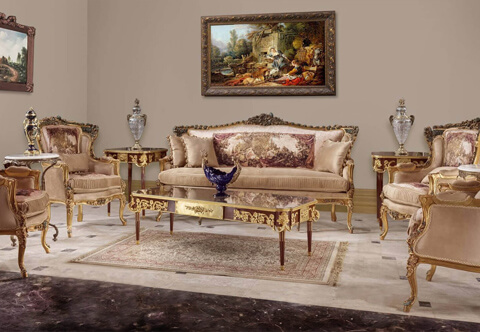
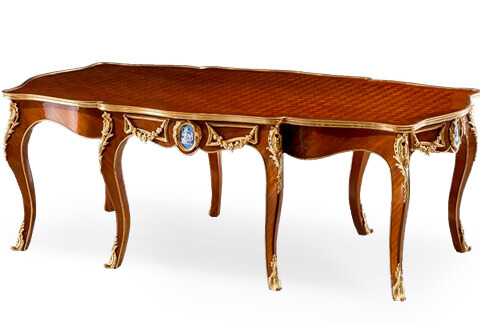
The fine armchair is part of an office set of the same design comprising of a one Sofa, two armchairs and center coffee table. Units can be increased per request.
The production of the fine armchair corresponds closely to the documented Linke Index No. 703, a model produced for both private commissions and exhibition display. Linke’s Rococo Revival seating drew heavily upon the 18th-century prototypes of the Garde-Meuble royal inventories, yet reinterpreted them with a pronounced sculptural dynamism and the highest quality gilt-bronze casting of the period.
During the Belle Époque, Linke stood at the forefront of Parisian luxury furniture, exhibiting at the Exposition Universelle of 1900, where his synthesis of historical forms and inventive ornament received international acclaim.
SN-8744
H:118 x W:60 x D:58cm
Louis XV Revival style | Belle Époque | Rococo Revival
Belle Époque (circa 1871–1914)
The Belle Époque denotes a period of sustained cultural, artistic, and technological flourishing in Europe—most notably in France—spanning from the aftermath of the Franco-Prussian War to the eve of the First World War. Characterized by optimism, prosperity, and rapid urban development, the era fostered an extraordinary renewal of the decorative arts. Paris emerged as a global center of luxury craftsmanship, where cabinetmakers, bronziers, and ébénistes refined traditional techniques while embracing modern innovations. Distinctive stylistic vocabularies reappeared in highly sophisticated revival forms, including Rococo, Louis XV, and Louis XVI idioms, enlivened by virtuoso marquetry, opulent ormolu mounts, and sculptural ornament.
The Belle Époque remains celebrated for its synthesis of historical grandeur with technical excellence, yielding works that exemplify the height of French artistry before the dramatic societal shifts of the twentieth century.
François Linke
Francois Linke (1855-1946) was arguably the leading Parisian cabinetmaker of the Belle Epoque the glittering age of fashionable French society, whose influence was felt throughout the world.
Determined to outshine the competition at the Exhibition, Linke had set about creating the most ambitious pieces he could envisage, and more extravagant than had ever been displayed before. The items he exhibited marked a transition from the historicist interpretation of Louis XV and Louis XVI styles, an interpretation that was the mainstay of his nearest rivals, to something startlingly new and vital in its immediacy. Together with Leon Message he developed a new style for the 1900 Exhibition that paid homage to the Louis XV rococo in the fluidity of its approach, but an approach fused with the lively flowing lines of the contemporary and progressive 'art nouveau'.
This risky endeavour was a resounding success, and with his reputation established, La Maison Linke became the pre-eminent furniture house until outset of the Second World War. The technical brilliance of his work and the artistic change that it represented was never to be repeated. His showrooms expanded into prestigious premises in Paris, in the Place Vendome as well as the Faubourg St. Antoine where his workshop had been established. He embarked on many important commissions in the years up to the outbreak of the First World War, making and designing furniture for leading international industrialists and bankers.
After the 1914-1918 World War, Linke undertook the extraordinary commission to furnish the Ras al-Tin Palace in Alexandria for King Fuad of Egypt, possibly the largest single furniture commission ever conceived, eclipsing even Versailles. Linke flourished and remained active until the middle years of the 1930s and died in 1946.